
Children too old to play?
Now that I am writing this, my almost 12-year-old son is playing and talking behind my back. Some of the toys he is playing with were given to him when he was at pre-school – by the grandma of a boy who had just started school; she said her grandson was already a student, so he did not need toys anymore. I know of many other children whose toys are taken away as they start elementary school. I have no idea if this happens in other countries, but it does happen in mine. Besides, it seems that too often children don’t mind that as they have already got addicted to digital play.
I also know children (even tweens) who are keen on playing with toys and coming up with complex scenarios, building elaborate setups and talking along as they play, and I have talked to some parents who feel a bit embarrassed about that, and a bit worried. Should they feel so?
What is symbolic play?
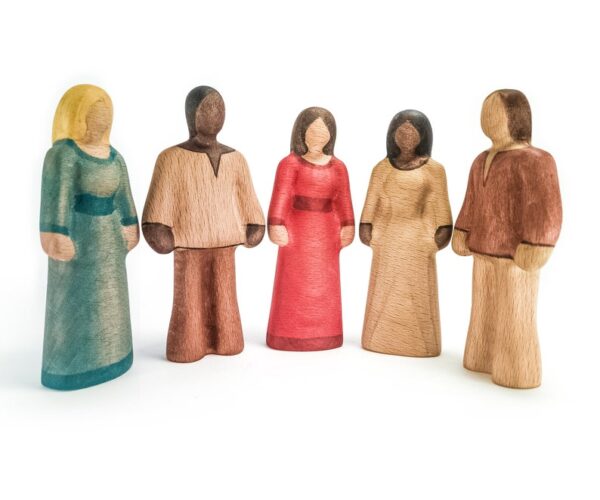
It is also called “pretend play”, “dramatic play”, “imaginative play”. Some people use these terms interchangeably, while others differentiate between them. An off-shoot is “small world play”. The essential elements found in these types of play, even when people differentiate between them are: adopting roles, acting out scenarios, using props (material or imaginary). Playing house is a typical example of symbolic play, and the variety of symbolic play scenarios are endless, and they can be inspired by practically anything. When I was a child, anything practised by adults / shown on TV / depicted in books served as raw material for our games. I still remember my mom growing incensed when she saw me “smoking cigarettes”, that is, elegantly holding blades of grass between my fingers and pretending to be sipping at a cup of “coffee”.
Isn’t that type of play weird?
Symbolic play is in fact natural, even though some children do not engage in it (for reasons I will discuss later). Child development experts say this type of play is really important. In my childhood (decades ago), parents never evaluated the academic worth of play (any type of play), and symbolic play was simply enjoyable and … practiced at all homes in every neighbourhood. We were truly devoted to it, and our setups grew richer and more elaborate, and of course, conquered every inch that was left unattended by adults. Both indoors and outdoors. That seems to have been the norm.
But how does symbolic play benefit children?
I will not go into neuroscience and lecture you about prefrontal cortex activation and executive function development. I will simply say that symbolic play is a serious cognitive challenge – a complex, non-routine task that indeed activates the prefrontal cortex because it is self-initiated, not forced by adults, and that also makes it truly enjoyable. Children are motivated to play, and through symbolic play they also learn and become better learners.
Let me say that again: symbolic play is an essential element of the total learning experience, and it appears to be among the most efficient and enjoyable. It is a rich, self-initiated, and self-directed experience, and it is intrinsically motivated, so it cannot be replaced by any play/learning experience initiated or led by adults.
Understanding Their World Through Role-Play
First, it helps children figure out the world they encounter. Unlike us, adults, children (especially younger ones) do not rely so much (or not at all) on conscious rational thinking to analyze life situations and phenomena. They get their insights from practical experience, and the only way for them to engage practically with many phenomena is through play. This is one of the reasons why they take on adult roles – to figure out adult reality in which they cannot take real (or at least important) part.
Processing Emotions and Healing
Second, it helps children to process painful experiences and come out of them in healthier ways. This is just one of the reasons why child psychologists stimulate children to engage in symbolic play.
Building Self-Awareness and Empathy
Third, children learn about themselves and others. They test their limits, experiment with different approaches to social situations. Getting into other people’s roles, they learn more about other people and become more understanding and sympathetic.
Developing Social and Communication Skills
Fourth, while engaging in pretend play with other children, they learn how to communicate, cooperate, negotiate, resolve conflicts, etc. This is the most natural way for children to become socialized.
Boosting Language, Narrative, and Academic Skills
Fifth, participating in developing storylines through dramatic play enables children to become experts in telling stories in sequence, persevere in storytelling, and learn to wait while others are talking. Their verbal skills develop much better, and that is later strongly related to literacy…and much more:
Lev Vygotsky emphasized that play creates a space in which children use language at a more advanced level than in everyday conversation. In play, language is not only communicative but also organizational – it helps children plan, reflect, and negotiate meaning.
Over time, this narrative competence supports reading comprehension, writing, and the ability to explain ideas clearly. These are foundational skills for learning across the curriculum, from humanities to science.
Fostering Imagination and Creative Problem-Solving
Sixth, they develop their imagination and divergent (lateral) thinking, i.e. they become capable of coming up with more than one solution to a problem, more than one approach, etc. – thus they grow up into more resourceful people.
Why some children do not engage in symbolic play
Some children are naturally reticent in cooperative play. Others feel adults’ disapproval. Still others have little practice in pretending. Some children might feel some cultural restrictions, especially about certain play scenarios. Other children are simply quite young.
However, if children show complete lack of interest in pretend play, they might have certain developmental, social or communicational delays or autism-spectrum disorder (ASD), so it is a good idea for parents to consult a paediatrician.
What if children do not get enough pretend play?
Researchers say that quality is more important than quantity, but in many cases quality grows out of quantity, or as the proverb goes, “Practice makes perfect”.
Limited symbolic play (both in terms of quality and quantity) leads to social-emotional deficits, such as difficulties with empathy, emotional regulation, and understanding different perspectives.
It can also present cognitive challenges, such as lower development of creative thinking, flexibility, and problem solving.
It could lead to delays in the development of communication and language skills, symbolic representation (the use of signs, symbols, images, words to stand for deeper meanings, abstract concepts, etc., all needed for academic success).
So, it seems that symbolic play is related to academic readiness?
It truly is.The capacities developed through symbolic play translate directly into academic contexts. Representational thinking supports mathematics and science. Narrative competence supports literacy. Perspective-taking supports discussion and collaborative work. Self-regulation supports attention and persistence.
For this reason many childcare providers position symbolic play as the core of their educational frameworks, not as just a pleasant fringe activity. Play is not an optional extra; it is one of the ways children prepare themselves for formal education.
Surely, we will discuss this aspect further in other resources we are about to create.
How can we encourage imaginative play?
First and foremost, adults should provide space where symbolic play can unfold, and second, they should make sure there are material props children can use. These two are essential. Then on and off adults can provide inobtrusive support, and then make sure they step back as quickly as possible. I will go into more detail in texts I hope to write soon.
Meanwhile you can take a look at our rich resource on play with toy animals – there is a lot you might wish to try out as soon as possible.

Lydia Staikova holds an MA in English and Bulgarian Literature and Linguistics from Shoumen University, where she studied pedagogy, psychology, and child development. She has taught English and counseled students for thirty years. She is a parent and homeschooled her children for several years. Lydia writes all editorial content on mrfoxcrafts.com. See full bio here.